
Coordinates
Spatial biology depends on more than where measurements are taken. It depends on how space itself is defined.
Most spatial data is still treated as if biology lives comfortably inside a simple Cartesian box. That works for some problems. It fails when meaning is carried by anatomy, polarity, curvature, interfaces, or growth.
Verdant treats coordinate choice as part of the measurement. It is not a downstream visualization decision.
One Specimen, Multiple Coordinate Frames
The figure below shows a single developing plant meristem represented under five different coordinate systems. The specimen does not change. The frame used to describe it does.
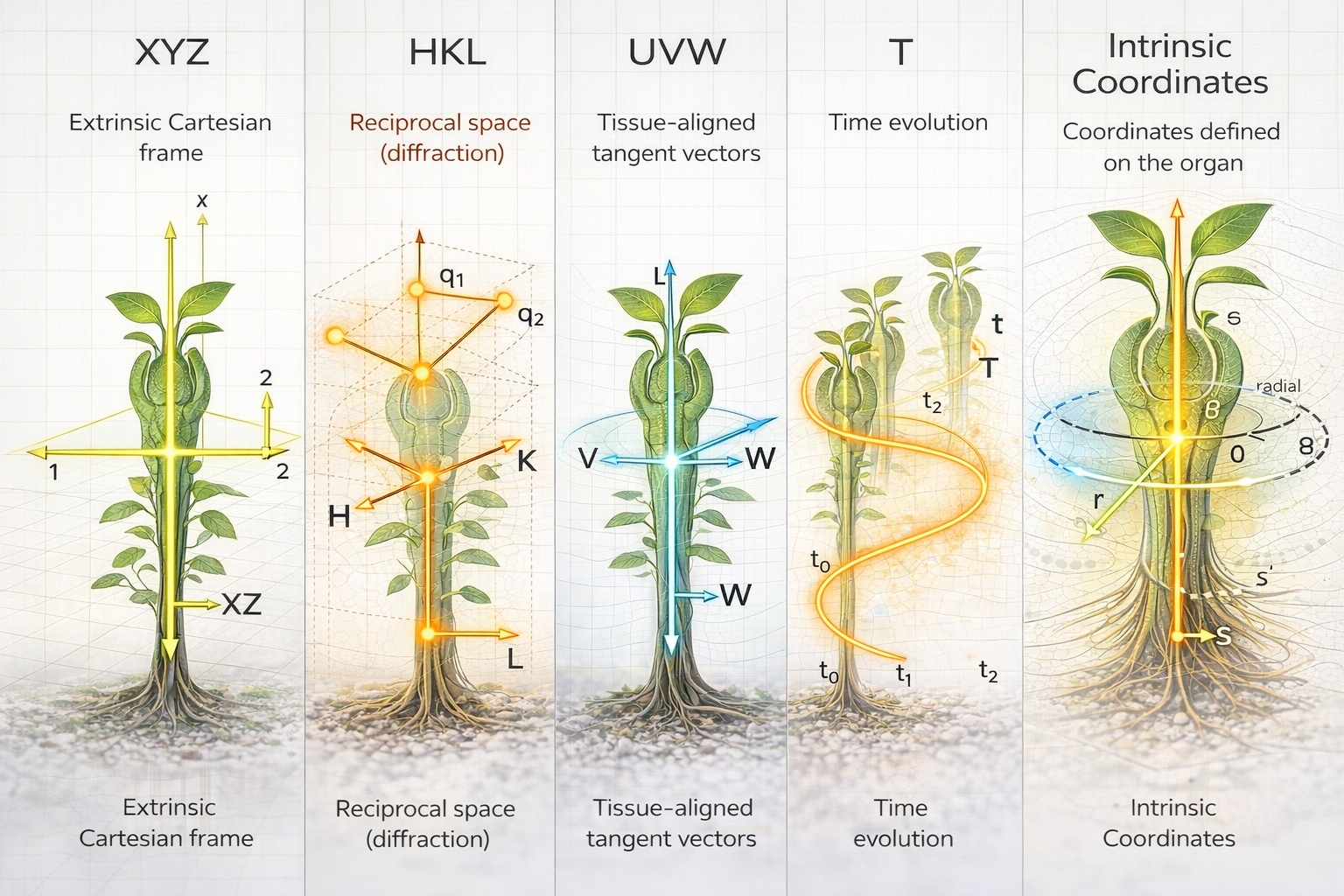
One specimen represented under five coordinate systems: XYZ, HKL, UVW, Time, and Intrinsic.
Common Coordinate Frames
XYZ
The external frame fixed to the instrument or stage. Useful for acquisition, alignment, and registration. Often blind to internal biological organization.
HKL
A structure-based indexing frame used when periodicity or ordered material organization matters. Direction and position are defined relative to internal structure rather than external axes.
UVW
A local orientation frame aligned to dominant specimen directions such as longitudinal, radial, circumferential, or boundary-normal axes.
Time (T)
Spatial systems change. Time alters the object being measured and therefore the coordinate system itself.
Intrinsic coordinates
Coordinates defined by anatomy, polarity, boundaries, gradients, lineage, or interfaces rather than by the microscope stage.
Why Coordinate Choice Changes the Science
A coordinate system is a claim about what counts as close, aligned, upstream, downstream, or comparable.
- False discontinuities when curved tissue is flattened into XYZ
- Misleading averages when interfaces carry more signal than bulk volume
- Brittle comparisons across orientation, growth stage, or morphology
- Hidden gradients when biology follows organ-aligned rather than global axes
Coordinate choice is a measurement decision. It determines which patterns can be seen.
How Verdant Uses Coordinate Frames
- Start in XYZ for acquisition and alignment
- Map into UVW to follow specimen-oriented directions
- Reference HKL-style frames when internal ordering matters
- Add Time explicitly when comparing development or perturbation
- Use intrinsic coordinates when interpretation depends on anatomy or boundaries
The goal is to preserve biological meaning while enabling rigorous computation.