Verdant

Center for Spatial Biology

Verdant Center for Spatial Biology

A nonprofit measurement discipline for spatial and environmental biology.

Verdant helps researchers translate living systems into measurements that can be observed, reproduced, and shared across laboratories, field sites, and instruments.

Verdant Center for Spatial Biology is a U.S. 501(c)(3) nonprofit research organization.

If your biology touches an environment, we map it.

Plants. Microbes. Marine life. Fungi. Animals. Soils. Sediments. Fossils. Materials.

What Verdant Does

Verdant works at the measurement layer of biology. We help teams design experiments where biological systems, environments, and instruments interact in ways that remain observable and interpretable.

Tool agnostic by default. The goal is interpretability, reproducibility, and long-term stewardship of methods.

Measurement Before Models

Most biological discovery fails not because of theory, but because systems cannot be observed clearly enough to support interpretation.

Verdant focuses on the layer where biological reality meets instrumentation. We help collaborators build measurement frameworks that stay stable across environments and platforms, so results remain meaningful beyond a single run.

We are not a contract lab. We are a commons for spatial measurement and interpretation.

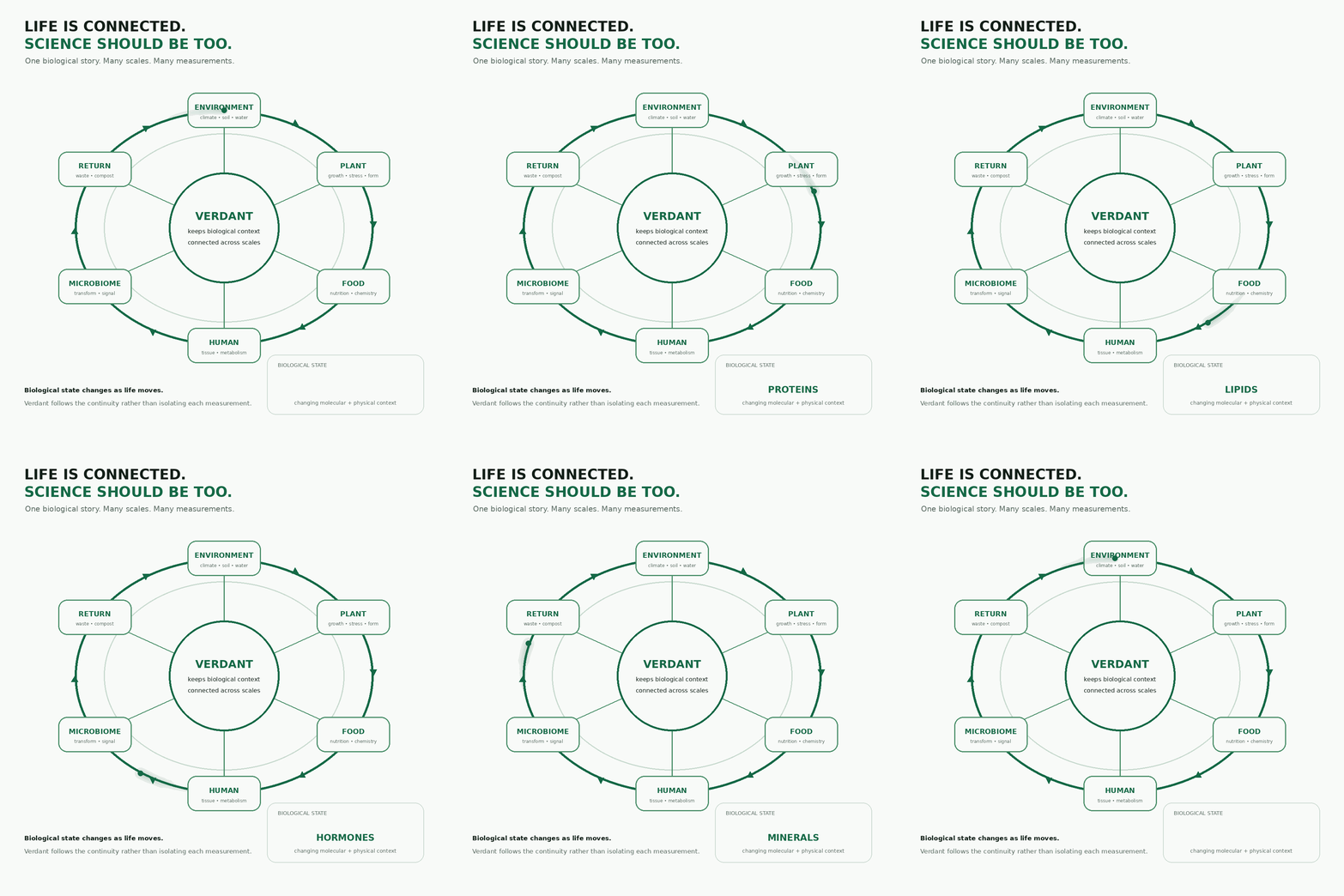
Context illustration
Verdant comic row

Example System Types

Plants and root systems

Growth, stress, transport, and spatial development under real constraints.

Marine ecosystems

Kelp forests, coastal gradients, and spatial coordination across communities.

Microbial communities

Structured guilds, niches, succession, and metabolite coupling in space.

Environmental gradients

Thermal, chemical, and mechanical gradients that shape biology.

Host–microbe interfaces

Where tissues and communities meet, and measurement bias becomes decisive.

Cross-kingdom signaling

Recurring spatial motifs across plants, fungi, microbes, animals, and sediments.

Many of the most interesting biological systems occur outside controlled laboratory environments.

Questions We Help You Answer

Where does it actually happen?

Spatial origins of processes such as toxin accumulation, metabolic hotspots, pathogen entry, root sensing, sediment microbe clustering, early development, and tissue failure points.

What fails first?

Early warning signals such as collapsing tissues, disappearing microbial guilds, predictors of drought, disease, spoilage, thaw, contamination, and metabolic precursors.

How do systems coordinate across scales?

Cells, tissues, organs, organisms, microbiomes, ecosystems. Emergent behavior driven by spatial organization and physical context.

What crosses kingdoms?

Deep biological parallels across plants, fungi, microbes, animals, and sediments, including shared stress logic and recurring spatial motifs.

How does environment shape biology?

Thermal, chemical, and mechanical gradients. Pollutants inside tissues. Root–fungus stress propagation. Sediment structuring. Diffusion limits that create surprises.

How do we design better systems?

Spatial markers for breeding and resilience. Clean-stock design. Propagation logic. Bio-inspired sensors. Measurement pipelines that reduce variance before compute.

Work with Verdant

Verdant collaborates with researchers, institutions, and foundations to design measurement frameworks and pilot systems for spatial biology.

View Engagement Models Contact

A Scientific Commons

Verdant operates as a nonprofit commons where researchers, field scientists, and institutions can share measurement frameworks and experimental approaches.

Knowledge generated through Verdant collaborations is intended to remain broadly usable across the scientific community.

Explore: wiki.verdantcfsb.com

Stewardship

Verdant maintains a growing Stewardship Collection documenting objects, organisms, and artifacts associated with collaborations.

This may include living plants placed in botanical gardens, scientific tools, artworks, and symbolic items contributed by collaborators. The collection serves as a long-term institutional record of Verdant’s work.

Have a question in your own language?

That works here.

Máte otázku ve svém jazyce? Funguje to.
¿Tienes una pregunta en tu idioma? Funciona aquí.
Vous avez une question dans votre langue ? Ça marche ici.
Hast du eine Frage in deiner Sprache? Das passt hier.
Hai una domanda nella tua lingua? Va bene qui.
Você tem uma pergunta no seu idioma? Funciona aqui.
你有用自己语言的问题吗?可以。